


Page 31 - Fundação MEO - Net Arte no Triângulo das Bermudas
P. 31
15. For the instability     spelling of terms referring to Internet-related artistic
           of terminology related to   practices . For example, the techno-artistic community
                                                15
           artistic practices and the
           Internet, see the text by   in Brazil, which was quicker to systematise its artistic
           Ponte & Rivero-Moreno in this
           publication.                production in this field, not only employs the term arte
                                                                    16
                                                                                  17
           16. See Nunes (2003).       cibernética but uses web arte  and web art  inter-
           17. See Anderaos (1997).    changeably. The array of existing designations reflects
           18. See Malina (1998, p.8).  the experimental and spontaneous dynamics inherent
           19. According to Barranha   to the medium – something Roger Malina describes as
           (2018), this is the most    “part of a fundamental process of acculturation”  in
                                                                                       18
           commonly used term to refer to
           these practices.            contemporary society. Thus, it falls upon each resear-
           20. I first applied the “Bermuda   cher, artist, or curator to determine their preferred
           Triangle” metaphor to analyse
           artworks in an exhibition   terminology, situating their choice within the historical
           context in Ponte (2020).
                                       processes that underpin it.
                             In the study and in the exhibition, both terms “net arte” and “net
                         art” were intentionally used. Two key reasons underpin this decision:
                         first, it reflects the process of acculturation that artistic practices
                         related to the Internet . No linguistic error was committed, as the
                                               19
                         term “net”, as illustrated in Figure 2, is fully assimilated into the
                         language, and there is no doubt about the legitimacy of the word
                         “arte”. Second, it acknowledges the sense of intrigue that both terms
                         provoke.
                             A borrowing and a Portuguese adaptation, “net arte” incorporates
                         the direct translation of the second term of the expression into
                         Portuguese orthography. Adopting it serves a dual purpose: on the
                         one hand, it sparks interest among those who had never considered
                         it (a vast majority); on the other, it piques the curiosity of those who
                         have been hesitant to (re)recognise the country’s techno-artistic past
                                       as an interesting historical, artistic, and cultural source.
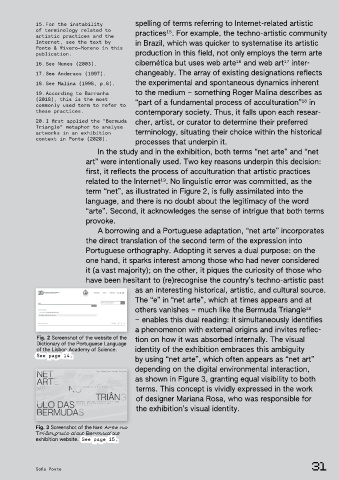
                                       The “e” in “net arte”, which at times appears and at
                                       others vanishes – much like the Bermuda Triangle
                                                                                        20
                                       – enables this dual reading: it simultaneously identifies
                                       a phenomenon with external origins and invites reflec-
           Fig. 2 Screenshot of the website of the   tion on how it was absorbed internally. The visual
           Dictionary of the Portuguese Language
           of the Lisbon Academy of Science.    identity of the exhibition embraces this ambiguity
           See page 14.
           See page 14.
                                       by using “net arte”, which often appears as “net art”
                                       depending on the digital environmental interaction,
                                       as shown in Figure 3, granting equal visibility to both
                                        terms. This concept is vividly expressed in the work
                                        of designer Mariana Rosa, who was responsible for
                                        the exhibition’s visual identity.

           Fig. 3 Screenshot of the Net Arte no
           Triângulo das Bermudas
           exhibition website.  See page 15.
                        See page 15.

                                                                                          31
           Sofia Ponte
           Sofia Ponte

